The hood
Ochre cloth and leather, faded by sun and repaired by hand. It keeps the glare off his eyes and dust out of his hair.

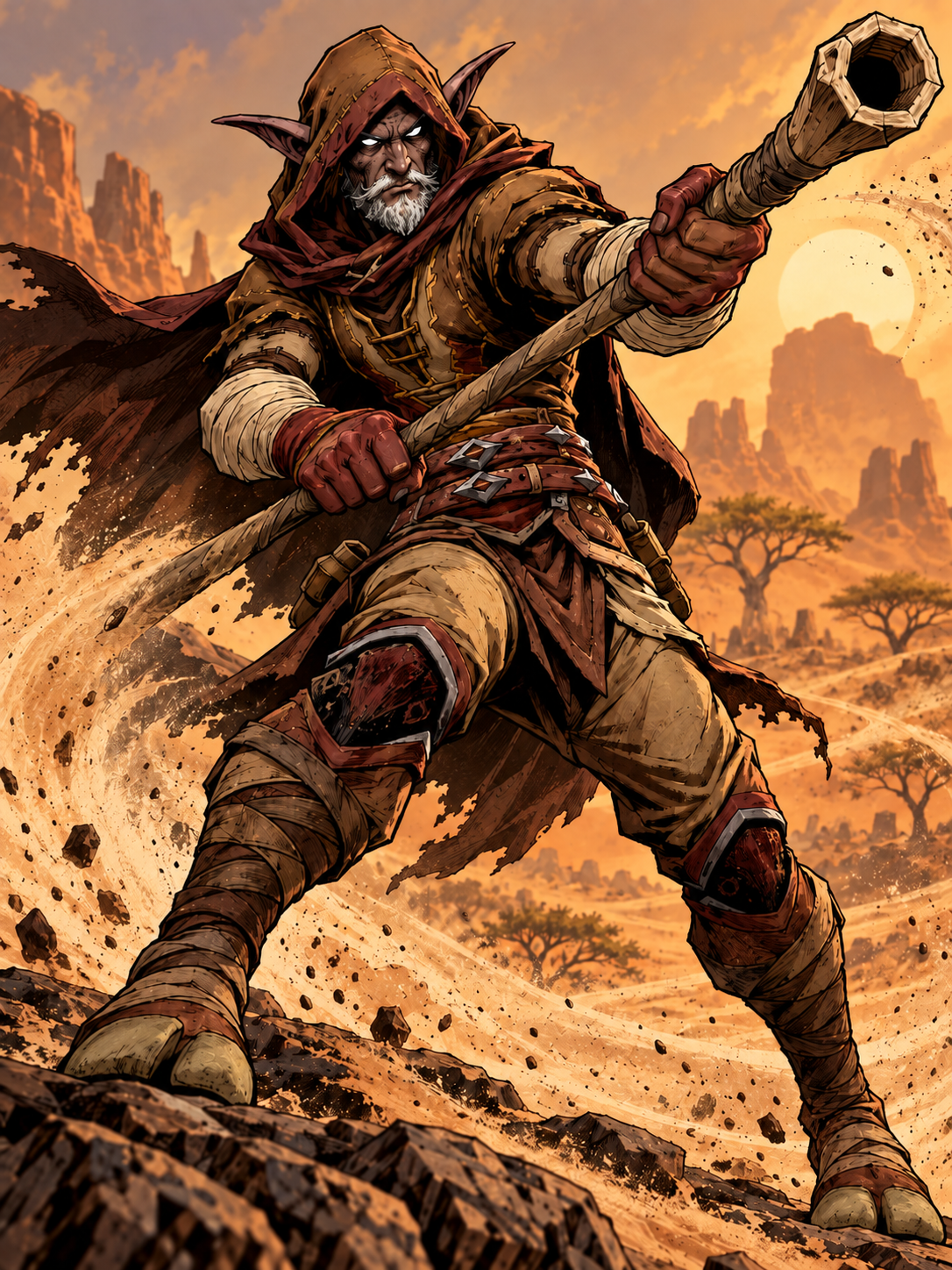
Cutter, called the Badger in the Barrens. An elder Kaldorei hunter and pathfinder who lives alone in a burrow and tunnel system beneath the Barrens.
“If you came for advice, sit down. If you came to give it, mind your head on the way out.”
The first thing most visitors hear is a voice telling them to stop standing on the roof.
Cutter emerges in patched ochre and brown, his white beard showing beneath a much-repaired hood. Pale eyes take in a visitor's boots before their face. He is solidly built, with work-worn hands and dust on his sleeves. A long wooden stave is usually within reach.
He makes little effort to be welcoming. He will still notice a limp, an empty waterskin, or someone too tired to stand. A cup might appear while he is complaining about the interruption.
Ochre cloth and leather, faded by sun and repaired by hand. It keeps the glare off his eyes and dust out of his hair.
Trimmed when it becomes inconvenient. His face is creased and weathered; he looks every bit the elder he is.
Brown layers, a battered scarf, wrapped forearms, and worn gloves. Most pieces have been mended rather than replaced.
A long, heavy length of wood. Useful on broken ground, in a low passage, or when someone ignores a warning.
Two broad, curved blades with worn edges and simple grips. Another part of his equipment, alongside the wooden stave.
A small round token bearing a paw print is kept with his gear. He has not offered an explanation for it.
Cutter grew up in Ashenvale during the Long Vigil, long after the Sundering. He hunted, found routes through difficult ground, and brought other people home along them. “Cutter” was a working name. His childhood name is something he keeps to himself.
He spent centuries doing ordinary things: repairing roofs, gathering supplies, keeping watch. Nordrassil's blessing gave his people time, but it did not protect friends who failed to return from a journey. Gradually, he spent longer away from settlements and became less willing to explain when he would be back.
The Barrens suited him. He liked the open country and learned to judge its water, shade, and distances. A shallow cavity beneath a ridge became a regular stopping place. He left a pot there, then spare cord and a blanket. On one return, something had dragged the blanket into a corner. He improved the entrance.
Each visit brought another job. He made the sleeping space dry, added shelves, and opened a second way out. Eventually he stopped pretending he was passing through.
No single quarrel drove him underground. He preferred his own routines, and fewer of the people he missed were still waiting elsewhere. Travelers started calling him the Badger in the Barrens. He accepted that. The suggestion that he could turn into one was less welcome.
He cannot. The hole was made with tools.
Born long after the Sundering, Cutter grows up among the forests of Ashenvale. Hunting and finding paths become his work.
He spends increasing stretches of time away from settlements, guiding small parties and learning the dry country farther south.
A shallow refuge in the Barrens becomes his regular lodging. He expands it slowly. Local travelers begin calling him the Badger.
Nordrassil’s sacrifice ends Kaldorei immortality. Cutter hears of Hyjal afterward. The loss changes his future, without suddenly aging him by thousands of years.
The shaking damages his burrow. He sleeps outside while repairing it, seals unsafe passages, and leaves possessions buried rather than risk retrieving them.
News arrives by the roads. He never lived in Teldrassil, but the dead are his people. He closes his home to visitors for several days before returning to his routines.
Cutter remains in his burrow. News reaches him through occasional trade and visitors; he rarely seeks either out.
The sign is for visitors. The badger appears to have an arrangement of its own.
A low opening beneath red earth and exposed roots. Beside it, a horned skull tops a rough “Keep Out” sign. The view reaches across open country toward the mesas.
Drying herbs hang overhead. Rolled bedding, wooden chests, a hooded lantern, and his battered mug sit within reach. The badger often sleeps beside his boots.
The floor drops low enough to stand. A narrow bed, table, fitted shelves, and wall hooks keep most of his belongings off the ground.
Branching tunnels lead to dry stores, a workspace, and a second exit farther along the ridge. He has gradually joined and enlarged natural cavities.
Supports, drainage, and ventilation need regular attention. Water is carried or collected and stored. Smoke leaves through a flue he keeps clear.
Some passages were abandoned after the Cataclysm. A few possessions remain beyond them. He expects guests to leave the barriers alone.
Cutter had put the bedding where he wanted it. The badger disagreed.
When he returned with his mug, it was asleep in the fold nearest his seat. He stood over it. One eye opened, then closed.
“Comfortable?”
He sat down, moving his heel clear of a paw. The light crept down the bank outside while he drank.
The animal has become part of his routine. He checks for it before shifting a chest and leaves it room beside the entrance. Whatever he calls it when they are alone has not been shared with visitors.
Later, he takes his mug up onto the ridge and watches the mesas turn red. When the air cools, he goes below, stepping around the badger on his way in.